3.2 Amplitude Comparison DF Systems
3.2.1 INTRODUCTION
Amplitude comparison DF systems comprise a circular array of N antennas equally spaced around 360° circle. The antennas usually have well-defined matched pattern responses so that direction can be inferred by determining the amplitude ratio of signals from two orthogonal voltages selected or synthesised from the array.
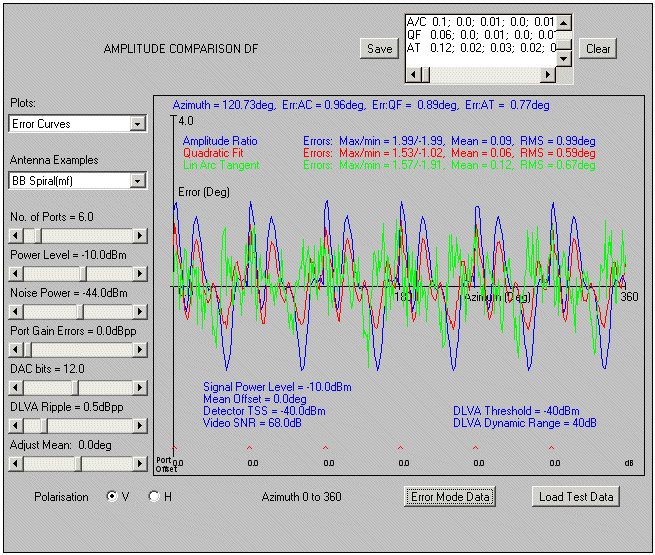
Applet 3.2.1 Amplitude Comparison DF
The applet allows three of the commonest Amplitude Comparison DF algorithms to be compared under realistic conditions. Example patterns are included, but there is a facility for the user to input own antenna patterns for evaluation.
Figure 3.2.1 shows the generic architecture of a multiport amplitude comparison DF system.
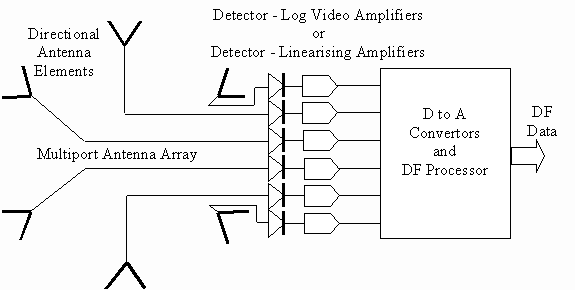
Figure 3.2.1 Generic Amplitude Comparison DF System
All the array antennas are identical with a polar pattern represented by f(θ). For equal antenna spacings, the angle between antenna pointing directions is φ, where φ = 360/N.
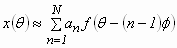
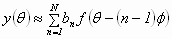
The general form for the orthogonally synthesized ratio signals is
(3.2.1)
a and b are constants chosen to ensure orthogonality between x(θ) and y(θ).
The ratio r(θ) of x(θ) and y(θ) is ideally, independent of signal amplitude and direction of arrival is recovered from
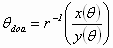
(3.2.2)
Here two adjacent ports containing the largest responses from a signal are selected for ratio measurement; then


(3.2.3)
r(θ) depends directly on the antenna pattern and is incorporated as a built-in system function.
Here, the mth port containing the largest signal is identified. Adjacent port pairs are compared and weighted (Reference 1) to provide a linear estimator assuming Gaussian-shaped antennas.


(3.2.4)
Functions fL(x), are now log-video.
This case minimises discontinuities at antenna boresights, optimises sensitivity, and features good immunity to antenna beamwidth variations and channel tracking errors.
r(θ) is a linear function when antenna patterns are essentially Gaussian and followed by log video amplification.
In this case, all port signals in Equation 3.2.1 are weighted vectorially before comparison in the manner:
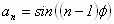
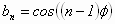
(3.2.5)
r(θ) is now less dependent upon antenna pattern and it is usual to use the approximation

(3.2.6)
The effect of small uncertainty in the values of x(θ) and y(θ) on the indicated angle in Equation 3.2.2 can be determined by differentiating r(θ) with respect to θ, denoted r'(θ).
Let
 , where R = r(θ), X = x(θ), and Y = y(θ)
Then
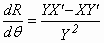 , where
  ,
,  ,
,  , and
, and 
Combining these equations and inverting, we get
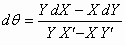
(3.2.7)
For the particular case of amplitude comparison system considered, Equation 3.2.7 can be used to model the system to determine the effect of system noise or channel tracking on DF performance achievable.
3.2.3.2 Angle Noise Estimation
In wideband ESM applications, the receiving channels following array antennas employ RF amplification prior to square-law detection. Assuming rectangular RF and video passbands, the signal-to-noise ratio at the detector output may be shown to be

(3.2.8)
where:
Ps is the received signal power on boresight.
f (θ) is the antenna pattern power response.
PT = the video tangential signal sensitivity.
b1 = BrBv – Bv2/2 for Bv<Br, else b1 = Br2/2.
b2 = Bv for Bv<Br/2, else b2 = Br/2.
Bv = the video bandwidth.
Br = the RF bandwidth.
G = the RF gain.
F΄ = F – 1/G and F is the RF chain effective noise figure.
k = Boltzmann’s constant.
T = the ambient temperature.
γ = an experimental constant = 8dB.
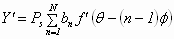
Channel noise voltages can be substituted in dX and dY to calculate angle noise error from Equation 3.2.7. Since the noise sources between channels are completely uncorrelated, video noise adds power-wise and total angle noise is given by

(3.2.9)
where
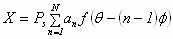
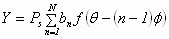
(3.2.10)
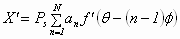
(3.2.11)
3.2.4 DF IMPROVEMENT TECHNIQUES
The bearing error circular autocorrelation function is a useful aid to identifying systematic features responsible for error contributions. The correlation function ripple frequency association with error sources can be investigated further by taking the Fourier transform of either the error function directly or of the correlation function itself. These spectra are directly related, with the correlation function transform providing the error function power spectrum. Transforming the derived correlation function provides directly the mean square error contribution of each ripple component.
Analysis of the resulting spectrum can provide insight into the mechanisms responsible for the system DF performance both in design and for measurement in the field. For instance, any consistent mean DF error gives rise to a DC term, whilst a component corresponding to the number of system ports arises due to antenna pattern deviations from ideal. Channel tracking errors, dependent on the sequence, can produce intervening components. A single failed or low gain port produces a single cycle error component.
Applet 3.2.1 includes this error spectrum analysis feature and outputs data to the data console on activating the error modes button
Factory calibration techniques can be used to give a moderate improvement in DF accuracy by compensating for parametrically stable error sources. These include antenna pattern and squint, RF channel gain, and log video/detector tracking differences. Closed-loop calibration can provide somewhat better compensation by using either the signal or a tunable oscillator to correct for amplitude and phase errors as a function of signal amplitude.
In general, the DF performance of an amplitude comparison DF system improves with the number of antenna channels. The optimum arrangement is when the antenna 3dB beamwidth matches the antenna angular spacing in the array.
An alternative configuration uses an N-channel amplitude comparison DF receiver that is switched between two concentric squinted N-port antenna arrays. Sets of DF measurements made alternately on the two arrays are combined to produce an improved bearing estimate. This approach maintains 100% single pulse intercept probability and allows the system to become sensitive to all signal polarisations by the use of cross-polarised antenna sets. Cross-polarised signals at either N-port array will not produce valid DF measurements and this can be sensed by inspecting adjacent channel signal amplitudes; the best DF accuracy possible in this situation is just that of the other copolarised array. Inverting elements in the arrays helps to compensate for antenna element pattern squint and switching to elements at opposite sides of the array compensates for channel unbalance. This technique can provide better than double the DF accuracy of a single antenna set.
3.2.4.3 Combined Amplitude and Phase Comparison
A 2N-port amplitude comparison DF system can be configured as N or 2N interferometer pairs; one pair is shown in Figure 3.2.2. Signal amplitudes from each of the 2N channels is used to produce a coarse DF estimate, which is used to resolve the relevant interferometer ambiguities.
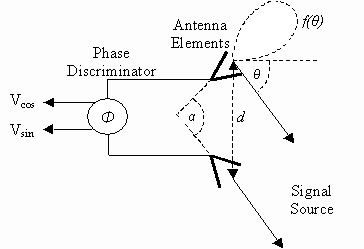
Figure 3.2.2 Squinted Antenna Interferometer Pair
Phase comparator output signals are

(3.2.12)

(3.2.13)
where, Ps is the signal power, θ is the source direction angle from the interferometer boresight, and f(θ) is the antenna power response.
An N-interferometer arrangement puts a difficult differential amplitude constraint on the phase discriminator because of the wider coverage required, but leads to a simpler overall system design. Figure 3.2.3 shows the required interferometer coverage for the N-pair configuration, which defines the limits on source angle for calculating ambiguity tolerance to amplitude comparison DF errors. For the 2N interferometer configuration, the required interferometer maximum field of view is just from –α to α relative to each interferometer pair boresight.
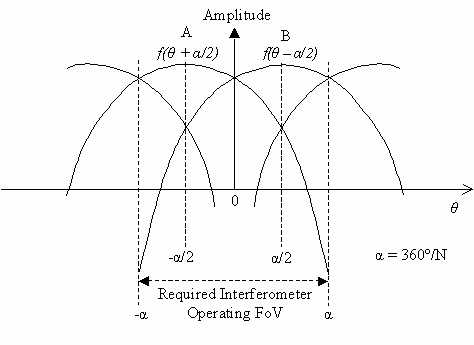
Figure 3.2.3 Interferometer Coverage for an N-pair Configuration
Amplitude Comparison DF Resolving Interferometer Ambiguity
Alternative methods of resolving interferometer ambiguities are by reference to some other coarser DF system such as an amplitude comparison system. If θ is the DF angle of the source and β is the elevation, then the permitted coarse DF measurement error allowed to just resolve the ambiguity in an interferometer with antennas spaced a distance d apart and phase measurement accuracy dφ is

(3.2.14)
This is summarised in the following applet.
Applet 3.2.2 Amplitude Comparison Resolving Interferometer Ambiguities
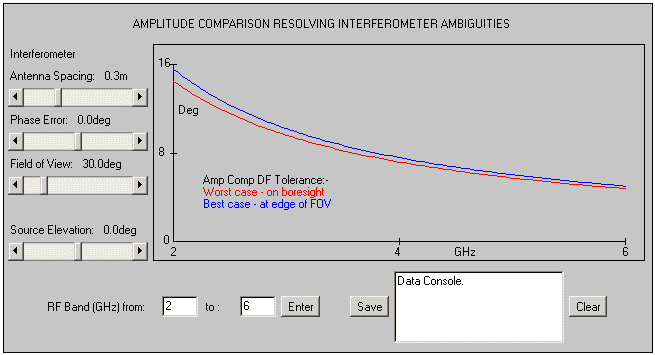
The applet indicates the maximum DF error allowed for a secondary DF system to successfully resolve colocated interferometer ambiguities.
3.2.5 REFERENCE
1. Stott, G.F., "DF Algorithms for ESM," Military Microwaves 88 Conference Proceedings, London England: July 1988.
3.2.6 SELECTED BIBLIOGRAPHY
Dybdal, R.B., "Monopulse Resolution of Interferometric Ambiguities," Trans IEEE, Vol. AES-22, No 2 March 1986.
Gething, P.J.D., Radio Direction Finding and Superresolution, (2nd Ed.), London England: Peter Peregrinus, 1991.
Lipsky, S.E., Microwave Passive Direction Finding, New York: John Wiley & Sons, 1987.
Nicolai, C., et al., "Broadband Crystal Video Front End for Radar Warning Receivers," Proc IEE Pt. F, Vol. 129, June 1982.